Dopamine Addiction: Why Your Brain Craves Distraction (And How to Take Control)
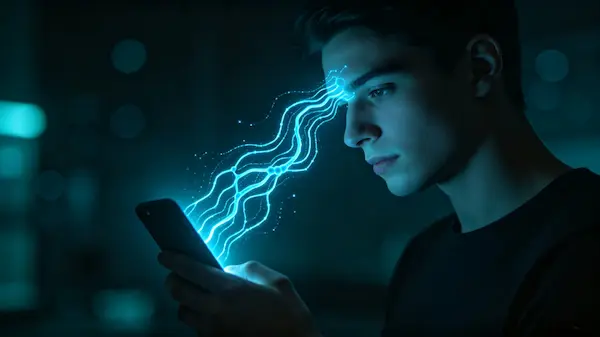
It’s 11:30 PM. You’re lying in bed, exhausted. Your body is screaming for sleep, but your thumb is still moving. Swipe. Double tap. Swipe. You’ve been watching 15-second clips of people cooking pasta you’ll never make and reacting to memes you’ll forget in three minutes. You tell yourself, “Just one more,” but you know it’s a lie. Your brain feels itchy, restless, and strangely hungry for more information that doesn’t actually satisfy you.
Feeling Overstimulated?
Before you dive deeper, grab our 7-Day Attention Reset Plan to break the cycle of digital noise and reclaim your calm.
Get the Free Reset PlanThis isn’t a lack of willpower. It’s not “laziness.” You are currently participating in the largest psychological experiment in human history. Your brain has been hijacked by a neurotransmitter designed for survival, now weaponized by Silicon Valley: Dopamine.
The Ghost in the Machine
Why is it so hard to put the phone down? To understand the dopamine addiction, we have to look at the “Reward Circuit.” In the wild, dopamine was a survival mechanism. It was the chemical that told our ancestors, “Hey, that berry is sweet! Remember where you found it so you don’t starve.” It wasn’t about the pleasure of eating; it was about the anticipation of the reward.
Today, the “berries” are notifications, likes, and infinite scrolls. Every time you pull down to refresh your feed, you are pulling the lever of a digital slot machine. Will it be a funny video? A work email? A like from a crush? The uncertainty is what keeps you hooked. This is instant gratification at its most dangerous—it provides a spike of dopamine without any of the effort our brains were evolved to exert.
How Short-Form Content Rewired Your Focus
If you’ve noticed your attention span shrinking, you aren’t imagining it. The rise of short-form content has changed the “physics” of our thinking. When you consume a 15-second video, your brain gets a hit of dopamine. Before that hit fades, the next video begins. This creates a high-frequency reward loop.
The problem? Your brain is highly adaptive. To protect itself from this constant bombardment, it begins to “downregulate” its dopamine receptors. It builds a tolerance. Now, normal life—reading a book, having a deep conversation, or working on a complex project—feels painfully boring. Those activities don’t provide the massive, instant spikes your brain has grown accustomed to.
This leads to a “Focus Debt.” We’ve already explored this in our Complete Guide to Fixing Your Attention Span, but the core issue remains: your brain is now addicted to the frictionless nature of distraction.
Why Your Brain Actually Craves Distraction
Modern distraction is often a form of emotional avoidance. When we feel a flicker of boredom, anxiety, or loneliness, we reach for the phone. It’s a digital pacifier. The “itch” you feel when you aren’t doing anything is your brain’s craving for that next hit to numb the discomfort of being alone with your thoughts.
But here is the hidden cost: The more you avoid boredom, the more you lose your creativity. Boredom is the space where the brain processes information and generates new ideas. By filling every micro-moment with “instant gratification,” we are starving our creative selves.
A Path to Digital Sovereignty
So, how do we fix it? A dopamine detox isn’t about living in a cave. It’s about resetting your baseline. It’s about moving from a state of being “used by your tools” to “using your tools.”
- Step 1: Identify the Friction. If your phone is the first thing you touch in the morning, buy a physical alarm clock. Move the phone to another room.
- Step 2: Reintroduce “Slow” Rewards. Trade 30 minutes of scrolling for 30 minutes of reading or walking without headphones. It will feel boring at first—that’s the “withdrawal” phase. Stay with it.
- Step 3: Systematic Reset. Your brain needs a period of low stimulation to allow those dopamine receptors to recover.
You don’t have to do this alone. The “itch” to check your phone will stay until you replace the habit with a structured system of focus.
Ready to Break the Addiction?
The first 24 hours are the hardest. Our 7-Day Attention Reset Plan gives you the exact daily prompts to navigate the withdrawal and rebuild your focus from the ground up.
Download the Free 7-Day PlanJoin 5,000+ others who have regained their focus this month.