The Truth About Multitasking: Why Your “Superpower” is Actually Killing Your Focus
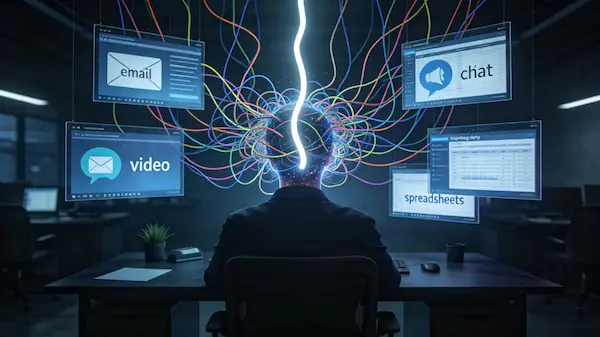
You know that feeling of being a productivity god? You’re on a Zoom call, answering three different Slack threads, and firing off an email—all at once. Your heart is racing, your fingers are flying, and you feel like you’re winning at the modern workplace. You think you’re getting ahead, but there’s a quiet, nagging weight in your temples. By 4:00 PM, you feel like a hollowed-out shell, unable to remember what you actually accomplished today.
Here is the hard truth: Multitasking is a biological lie. Your brain is not a parallel processor; it is a serial one. When you think you are multitasking, you are actually engaging in “context switching”—flicking your attention back and forth at lightning speed. And every time you flick that switch, you pay a “cognitive tax” that drains your energy and leaves your work riddled with invisible errors. You aren’t doing more; you are simply doing everything worse.
🛑 Stop the “Switch-Switching” Loop Today
If you’re feeling the symptoms of digital exhaustion, your brain needs a hard reset. Grab our 7-Day Attention Reset Plan to reclaim your deep focus and stop the cycle of constant distraction.
Get My Free Reset PlanThe Story of the “Busy” Illusion
We’ve been conditioned to believe that “busy” equals “effective.” In the world of high-functioning anxiety, multitasking is often used as a shield. We keep our hands moving and our tabs open because the moment we slow down, we have to face the overwhelming mountain of work ahead of us.
I once worked with a developer who prided himself on “coding while chatting.” He had four monitors and felt like he was living in the future. But when we looked at his output, his code was full of bugs that took hours to fix—hours he wouldn’t have spent if he had just focused on one task at a time. This is a classic case of brain overstimulation. He wasn’t faster; he was just noisier. He was caught in a dopamine loop, where every notification felt like a “win,” even though his actual progress was stalling.
The Neuroscience: Why Your Brain “Glitches”
The neuroscience of focus tells us that when we switch tasks, our brain has to “load” a new set of rules and data into our working memory. This doesn’t happen instantly. Research shows it can take up to 23 minutes to return to a state of flow after a single interruption.
If you switch tasks every five minutes, you are effectively living in a permanent state of cognitive “reloading.” This leads to analysis paralysis, where you have so many threads open that you can’t make a single decisive move. It’s not just your productivity that suffers; your IQ actually drops by 10 points during these switching periods—equivalent to the effect of losing a full night’s sleep.
— Publilius Syrus
The Cost of the “Always-On” Culture
In 2026, the pressure to multitask has only intensified. We aren’t just fighting our own urges; we are fighting AI-driven information overload. Our devices are designed to keep us in a state of “continuous partial attention.”
This constant flickering causes chronic stress and anxiety. When your brain is always searching for the next ping, your nervous system stays in a “fight or flight” mode. This is why you feel so exhausted even if you haven’t left your chair all day. You are literally wearing out your prefrontal cortex.
Breaking the Cycle: The Path to Single-Tasking
To fix this, we need to move toward Cognitive Design. We have to design an environment that protects our focus rather than exploiting it. Here are the core pillars of reclaiming your brain:
1. Use AI as a Filter, Not a Feed
Stop letting AI feed you more data. Instead, lean into using AI for self-awareness. Set up filters that gatekeep your attention. If an AI tool is making you think less and scroll more, it’s not a tool; it’s a distraction. Learn how to use AI without losing critical thinking to keep your brain in the driver’s seat.
2. Practice Somatic Resetting
When you feel the urge to open a new tab because your current task feels “boring,” that is your brain hunting for a dopamine hit. Stop. Use grounding techniques or breathwork to settle your nervous system. Sixty seconds of deep breathing can break the “switch” impulse and keep you on track.
3. Master the Art of the “Clean Slate”
Before moving from one task to another, perform a “mental dump.” Use AI journaling to clear your thoughts. This ensures that the “residue” of the previous task doesn’t bleed into the next one, allowing for true deep focus.
Summary: Your Focus Recovery Checklist
- Close the Tabs: If you aren’t using it right now, it’s a distraction.
- Audit your Dopamine: Recognize the “ping-hit” cycle and use digital minimalism to break it.
- Identify Overstimulation: Learn the signs your brain is overstimulated before you hit the wall.
- Practice Self-Compassion: If you slip up, don’t spiral into rumination. Just close the tab and start again.
The world doesn’t need more “busy” people. It needs people who can think deeply, solve complex problems, and remain present. By killing the multitasking myth, you aren’t just getting more done—you are getting your life back. If you’ve realized your attention span is fractured, don’t panic. You can fix it with the complete guide to fixing your attention span.
Ready to Build a “Distraction-Proof” Brain?
The multitasking trap is deep, but the way out is simple. Join thousands of others who have used our 7-Day Attention Reset Plan to silence the noise and rediscover their cognitive edge.
Start Your 7-Day Reset Now