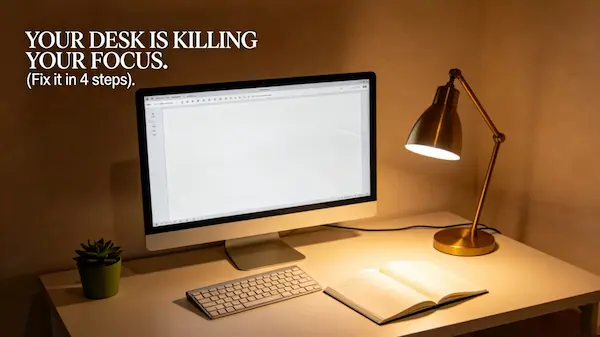
The Quiet Workspace: Simple Environment Hacks to Reclaim Your Attention
We’ve all sat down with the best intentions. You have your warm coffee, a clear goal, and your laptop open. But within ten minutes, you are adjusting your chair. Then you notice a stack of random receipts in your peripheral vision. Your phone’s screen lights up on the edge of your desk, and your neighbor starts leaf-blowing outside. Before you know it, an hour has evaporated, and you’ve written exactly two sentences.
When you struggle to maintain focus, you might blame your willpower. But willpower is a finite resource. A far more realistic culprit is your physical and digital environment. If your space is constantly competing for your attention, your prefrontal cortex runs on overdrive just trying to filter out the noise. It is a rapid path to feeling like your brain is chronically overstimulated.
To truly protect your mind, you must stop fighting your surroundings. Instead, you need to hack them. By intentionally engineering your workspace, you can make deep focus the path of least resistance.
How Your Surroundings Quietly Steal Your Focus
Human brains did not evolve to sit in cubicles staring at glowing glass while ignoring hundreds of background stimuli. From an evolutionary perspective, a sudden movement in your peripheral vision or a sharp background noise meant danger. Today, those ancient survival instincts are constantly triggered by messy desks, flashing screens, and open-plan offices.
This ongoing sensory bombardment exhausts your cognitive energy. Research shows that even a phone sitting face-down on your desk drains your “cognitive capacity” because your brain actively exerts energy to resist picking it up. This silent mental drain is a primary driver behind why focusing feels so difficult in the modern workspace.
By creating a “visually quiet” environment, you free up massive reserves of mental energy, allowing you to naturally rebuild your attention span over time.
Desk Setup Hacks: Out of Sight, Out of Mind
Your desk is your cognitive launchpad. If it’s cluttered, your thoughts will mirror that chaos. Here are three simple, high-impact desk hacks to clear the slate:
- The “One-Touch” Desk Rule: Only allow items on your desk that are directly relevant to your *current* task. Everything else—notebooks for other projects, coffee mugs, and loose cords—belongs in a drawer.
- The 20-Foot Phone Rule: Do not keep your phone on your desk. Put it in another room, or at least across the room inside a drawer. If you have to stand up to check a notification, you break the unconscious twitch of impulsive dopamine scrolling.
- Introduce Natural Anchors: Place a small green plant or a physical timer on your desk. These visual elements provide a calming anchor for your gaze when you take quick micro-breaks to rest your eyes.
Struggling with Daily Attention Fluctuations?
Your space is just the first step. If you’re ready to systematically detox your brain from digital noise and restore your cognitive power, download our step-by-step 7-Day Attention Reset Plan today.
Download the Attention Reset PlanTuning Your Workspace: Light and Noise Adjustments
Our sensory nervous systems are incredibly sensitive to sound and light, yet we rarely optimize them for deep brain performance.
1. Lighting for Alertness
Avoid harsh, blue overhead fluorescent lighting. It mimics midday sun and triggers a stress response, making you anxious. Instead, utilize warm, indirect lamp lighting pointed toward your walls or desk surface. This creates a “cave effect” that naturally funnels your attention to your screen. During the day, position your desk near a window—natural morning light is key to keeping your biological clock in sync, which works hand-in-hand with healthy morning habits to prevent afternoon energy crashes.
2. Sculpting Your Sonic Space
Complete silence can actually be distracting because every minor click or distant cough jolts you out of focus. Instead, use sound to mask distractions. Try listening to brown noise, pink noise, or video game soundtracks (which are designed by neuroscientists to keep players engaged without distracting them with lyrics). If you are working in a noisy room, invest in a reliable pair of active noise-canceling headphones—they are a tool for cognitive preservation.
Digital Walls: Tools to Block Digital Detours
Your physical environment isn’t your only workspace; your screen is, too. You cannot expect to practice mindful digital habits if your computer is constantly tempting you with notifications.
To defend your screen time, you need digital walls:
- Use App Blockers: Tools like *Freedom* or *Cold Turkey* allow you to lock yourself out of social media and news sites during your working hours. Do not rely on self-control—outsource it to technology.
- Full-Screen Mode: When writing or analyzing, maximize your window to hide your desktop icons, your browser tab bar, and your dock. If you don’t see your email icon, your brain won’t feel the pull to click it.
- Grayscale Phone Mode: Strip the color from your mobile device. Removing the vibrant red and orange notification badges instantly reduces your brain’s chemical desire to check your phone.
Additionally, remember that resting your mind physically is just as crucial as digital boundaries. Stepping away for brief periods of light physical movement acts as a biological reset, clearing away the mental clutter that accumulates on busy workdays.
Summary: Building Your Focus Haven
A focused life is not about having superhuman mental strength. It is about creating an environment where distraction is difficult and concentration is effortless. Clean your desk, control your senses, block your digital detours, and let your environment do the heavy lifting for you.
Ready to Optimize Your Lifestyle for Peak Focus?
Workspace optimization is only one piece of the puzzle. Explore our comprehensive lifestyle blueprint for sleep, nutrition, environment, and cognitive training.
Unlock The Human Edge Blueprint